–last updated December 19, 2020
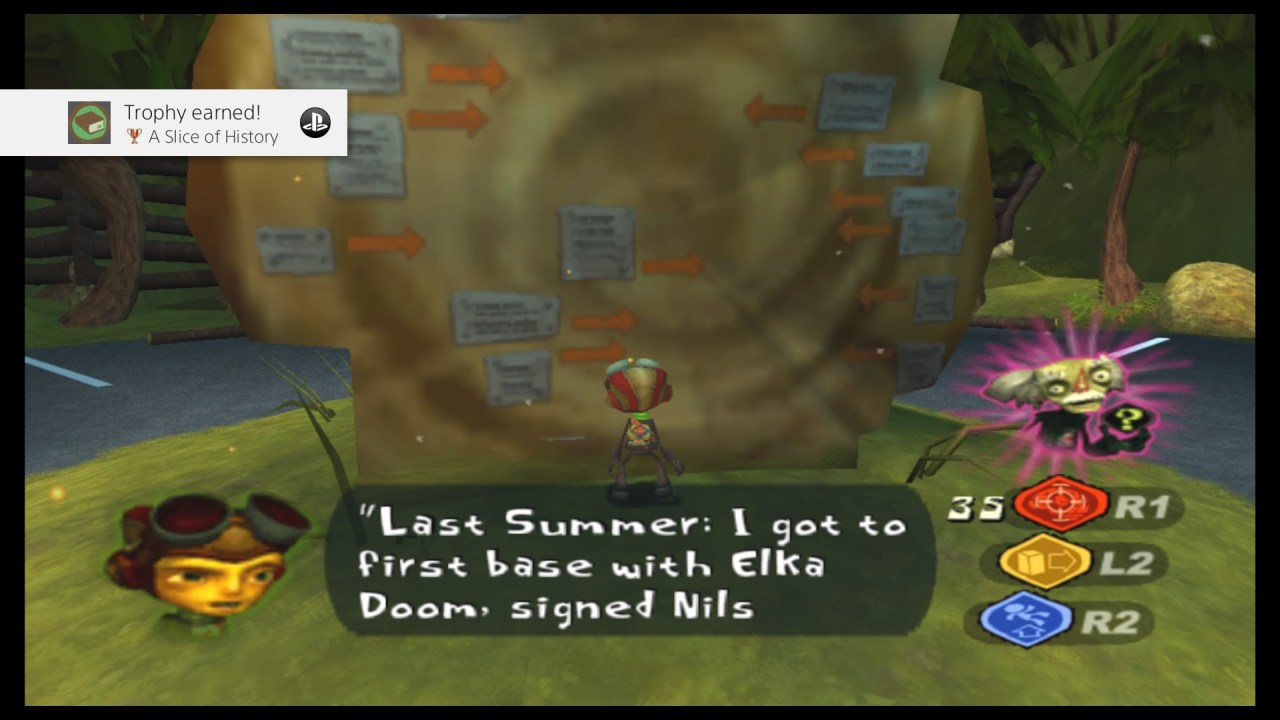
Recently, I had the privilege of playing an old gem. I’m referring, of course, to Double Fine Productions’ Psychonauts, a now-cult-classic from the days of the PlayStation2. I was 10 years old when the game was released, and I think I remember seeing it on a Blockbuster shelf. I never got around to playing it as a child, but I really wish I had. Apparently, this experience wasn’t unique because Psychonauts was not commercially successful. After playing it for myself, I can’t tell you why that was.
From the very beginning, Psychonauts had me hooked. In the game, we follow 10-year-old Raz (Razputin), a gifted circus runaway who infiltrates Camp Whispering Rock Summer camp, a program for psychic children. The camp trains psychics on how to control and develop their powers, with the potential to one day join a clandestine group of the elite psychics, known formerly as the Psychonauts. Coincidentally, the Psychonauts have their own comic book, which the game makes numerous inner references to via exposition from Raz. Owned by no one, the mysterious organization moves in the shadows, waging psychic wars to serve purposes beyond understanding. At least that is how Raz saw them.
Psychonauts starts off with a psychic bootcamp led by one the camp’s instructors, Coach Oleander, to introduce the campers and player to the controls and general feel of the game. This experience establishes the precedent that each level within the game will be within the mind of one of the game’s characters. In the first level, Oleander’s Basic Braining, we witness the manifestations of both conscious and subconscious content from Coach Oleander. This tutorial is reminiscent of an active warzone, complete with explosions, barbed wire, and airplanes. Oleander has some baggage – literally. Playing on the endless comic potential available with such content matter, in Psychonauts, emotional baggage serves as one of many collectibles. Finding all of these unlock bonus content like concept art and character backstories, which I enjoyed unlocking and viewing.
The cartoonish style of Psychonauts does a superb job of tastefully humorizing serious concepts, like war, while also introducing psychology and subconscious trauma in a way that is entirely enjoyable. If you actually gather the collectibles throughout the game, you will discover that many of the game’s characters have major issues hidden beneath the surface. It really got me to consider how many people I probably meet every day that are secretly living in their own warzone.
Along with the camp staff and campers, we quickly discover that Raz possesses a talent for developing and managing psychic abilities. Before long, he’s running circles around most of the other kids. He’ll pick up various psychic abilities, like using hid mind to blast enemies from afar. By the end of the game, Raz is much more powerful and mobile than he was at the beginning. This development feels entirely natural, and any challenge that you and Raz overcomes does not feel forced. It made sense when Raz won or lost. It is always refreshing when this is the case, as it demonstrates very strong writing and plot.
Speaking of writing, Psychonauts is a masterpiece. The story itself is as believable as it is ridiculous, and enjoyable paradox that kept me coming back for more. Jokes and archetypes portrayed by the cast were often time hilarious and interesting, making me laugh out loud or question what I would have done in those situations. Raz is not just a vessel for the player. Often, after I steered him into interacting with objects or characters throughout Whispering Rock, Raz would express his own perspective. These moments were enjoyable because it felt like Raz was actually part of the story. The plot was predictable at times, but part of that could be because the gaming stereotypes exhibited in the game were probably less cliché back when Psychonauts was new.
The main story was not the only enjoyable part of the game; the other campers had their own objectives. One hunted for an invisible, hairless bear while another become involved in a squirrel conspiracy (you read that right). Each level had its own distinct feel and mechanics. One level ran like a classic platformer, while another felt like I was steering Godzilla in one of their own movies. Often the new powers would be the central mechanic of the level it was introduced in, while also demanding that the player mastered previous mechanics to progress. I really enjoy the main menu, where you control Raz running on an actual brain to load into your save.
Compared to games today, I found the style and character of Psychonauts to feel very original. It has become one of my recent favorites. The game never felt like it was trying to be anything other than itself, and I can see why it gathered a cult following. I only wish I wasn’t late to the party on this one. Better late than never, because I will be one of the first excited fans to play Psychonauts 2.
 Barry Smith Jr.